
1. Why is diffusion insufficient to meet the oxygen requirements of multicellular organisms like humans?
Solution:
Multicellular organisms like humans have large bodies and need a large amount of oxygen to reach all their cells quickly. However, diffusion is a very slow process and cannot transport oxygen efficiently throughout the entire body. Due to its slow rate, diffusion alone is not sufficient to meet the oxygen requirements of multicellular organisms such as humans.
2. What criteria do we use to decide whether somethi
lticellular organisms like humans have large bodies and need a large amount of oxygen to reach all their cells quickly. However, diffusion is a very slow process and cannot transport oxygen efficiently throughout the entire body. Due to its slow rate, diffusion alone is not sufficient to meet the oxygen requirements of multicellular organisms such as humans.
2. What criteria do we use to decide whether someth
ng is alive?
Solution:
Walking, breathing, growth, and other visible movements help us determine whether something is alive or dead. However, some living things show life processes that are not visible to the naked eye. Therefore, the presence of life processes is the basic criterion for deciding whether something is alive.
3. What are outside raw materials used for by an organism?
Solution:
Organisms use external raw materials such as food and oxygen for their survival. The requirement for these raw materials depends on the complexity of the organism and the environment in which it lives.
4. What processes would you consider essential for maintaining life?
Solution:
Life processes like respiration, digestion, excretion, circulation, and transportation are essential for the maintenance of life.
.
Page Number 87
1. What are the differences between autotrophic nutrition and heterotrophic nutrition?
Solution:
|
Autotrophic Nutrition |
Heterotrophic Nutrition |
|
Organism prepares its own food and is not dependent on any other organism. |
An organism that does not prepare its own food and is dependent on other organisms for food. |
|
Food is prepared from CO2, water, and sunlight. |
Food cannot be prepared from CO2, water, or sunlight. |
|
Chlorophyll is required for food preparation. |
Chlorophyll is not required for food preparation. |
|
Green plants and certain bacteria have autotrophic modes of nutrition. |
All animals and fungi, most bacteria, have heterotrophic modes of nutrition. |
2. Where do plants get each of the raw materials required for photosynthesis?
Solution:
Plants require the following raw materials for photosynthesis:
- Carbon dioxide (CO₂): Obtained from the atmosphere through the stomata.
- Water: Absorbed by the roots from the soil.
- Sunlight: Acts as an essential source of energy for photosynthesis.
- Nutrients: Taken up by the roots from the soil.
3. What is the role of the acid in our stomach?
Solution:
The hydrochloric acid (HCl) present in the stomach helps dissolve food particles and creates an acidic medium. In this acidic environment, the protein-digesting enzyme pepsinogen is converted into its active form, pepsin. Additionally, HCl acts as a protective barrier by killing many disease-causing microorganisms that enter the stomach.
4. What is the function of digestive enzymes?
Solution:
Digestive enzymes break down complex food molecules into simpler forms, making the process of absorption easier and more efficient. The absorbed nutrients are then transported by the blood to all parts of the body.
5. How is the small intestine designed to absorb digested food?
Solution:
The small intestine contains tiny projections called microvilli, which increase the surface area and make absorption more efficient. Inside the villi are numerous blood vessels that absorb the digested food and carry it into the bloodstream. The blood then transports these nutrients to all parts of the body.
Page Number 91
1. What advantage over an aquatic organism does a terrestrial organism have with regard to obtaining oxygen for respiration?
Solution:
Terrestrial organisms breathe using the oxygen present in the atmosphere, while aquatic organisms obtain oxygen that is dissolved in water. Since the oxygen level in the atmosphere is much higher than in water, terrestrial organisms do not need to breathe rapidly. However, aquatic organisms must breathe faster to take in the required amount of oxygen.
2. What are the different ways in which glucose is oxidised to provide energy in various organisms?
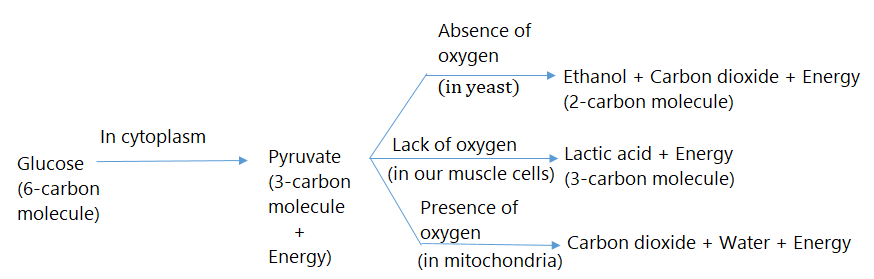
Solution:
In the cytoplasm, Glucose is first broken down into two 3 carbon compounds called pyruvate by the process known as Glycolysis. Further breakdown takes place in different organisms by different processes.
3. How are oxygen and carbon dioxide transported in human beings?
Solution:
In human beings, oxygen and carbon dioxide are transported through the bloodstream. Oxygen is carried from the lungs to the body cells, while carbon dioxide is carried from the cells back to the lungs. The exchange of these gases occurs between the alveoli of the lungs and the surrounding blood capillaries. Oxygen diffuses from the alveoli into the blood capillaries, and carbon dioxide diffuses from the blood capillaries into the alveoli.
4. How are the lungs designed in human beings to maximise the area for the exchange of gases?
Solution:
- The lungs are vital organs of the body. Inside the lungs, the passage divides into smaller and smaller tubes that finally end in tiny balloon-like structures called alveoli.
- The alveoli provide a large surface area for the exchange of gases and have walls rich in blood vessels. When we breathe in, our ribs are lifted, and the diaphragm flattens, making the chest cavity larger.
- This expansion causes air to be drawn into the lungs, filling the alveoli.
- The blood carries carbon dioxide from the body to the alveoli and absorbs oxygen from the alveolar air to transport it to all body cells. During normal breathing, a small amount of air always remains in the lungs to ensure enough time for oxygen absorption and carbon dioxide release.
Page Number 96
1. What are the components of the transport system in human beings? What are the functions of these components?
Solution:
The heart, blood, and blood vessels are the main components of the circulatory or transport system in human beings.
Functions of these components
Heart
The heart pumps oxygenated blood throughout the body. It receives deoxygenated blood from the various body parts and sends impure blood to the lungs for oxygenation.
Blood
Blood transports oxygen, nutrients, CO2, and nitrogenous wastes.
Blood vessels
Blood vessels, arteries and veins carry blood to all parts of the body.
2. Why is it necessary to separate oxygenated and deoxygenated blood in mammals and birds?
Solution:
Mammals and birds are warm-blooded animals that maintain a constant body temperature regardless of the surrounding environment. This process requires a large amount of oxygen for increased cellular respiration, allowing them to produce enough energy to regulate their body temperature. Therefore, it is essential for warm-blooded animals to keep oxygenated and deoxygenated blood separate to maintain an efficient circulatory system.
3. What are the components of the transport system in highly organised plants?
Solution:
In highly organized plants, there are two types of conducting tissues that carry out the transport system:
- Xylem
- Phloem
The xylem conducts water and minerals from the roots to other parts of the plant, while the phloem transports food materials from the leaves to the rest of the plant.
4. How are water and minerals transported in plants?
Solution:
The xylem, made up of tracheids and vessels in the roots, stems, and leaves, forms a continuous network of water-conducting channels that extend throughout the plant. Transpiration creates a suction pressure that pulls water into the xylem cells of the roots. As a result, water moves steadily from the root xylem to all parts of the plant through these interconnected conducting channels.
5. How is food transported in plants?
Solution:
Food is transported in plants through a special tissue called the phloem. The phloem carries food materials from the leaves to different parts of the plant. The transportation of food in the phloem requires energy, which is provided by ATP. This energy increases the osmotic pressure in the phloem tissue, causing water to move and generate pressure that pushes the food materials toward areas of lower pressure. This process ensures that food is distributed to different parts of the plant as needed. An example of such transported food material is sucrose.
Page Number 98
1. Describe the structure and functioning of nephrons.
Solution:
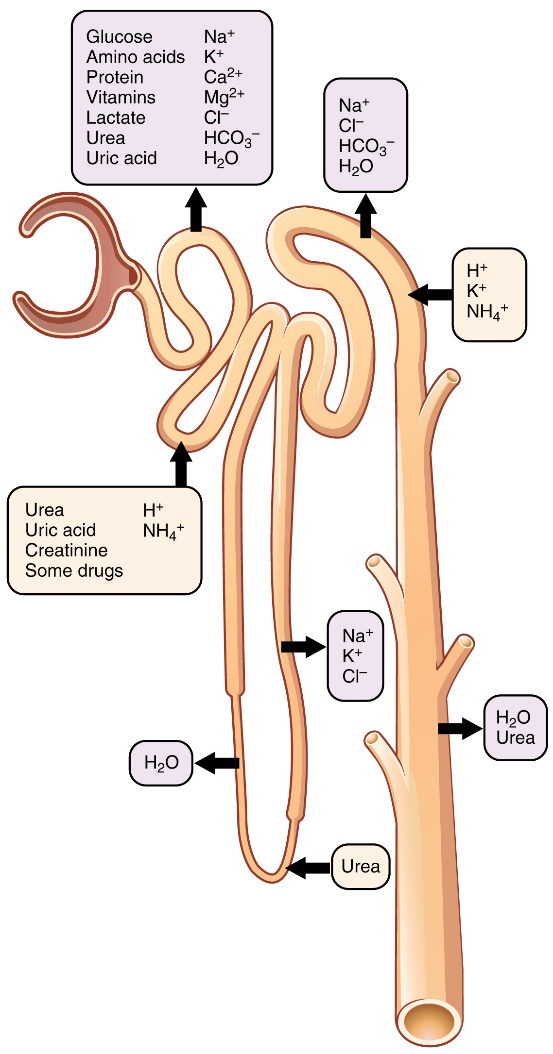
Nephrons are the filtration units of the kidneys and are present in large numbers. As urine passes through the nephron, certain substances from the initial filtrate — such as glucose, amino acids, salts, and a major portion of water — are selectively reabsorbed.
The main components of a nephron are:
- Glomerulus
- Bowman’s Capsule
- Long Renal Tubule
Structure of Nephron:
Each nephron consists of a glomerulus enclosed in Bowman’s capsule, followed by a long, coiled renal tubule where filtration, reabsorption, and urine formation take place.
Functioning of Nephron
- Blood enters the kidneys through the renal artery, which divides into many capillaries associated with the glomerulus.
- Water and soluble substances are filtered from the blood into the Bowman’s capsule.
- In the proximal tubule, useful substances such as amino acids, glucose, and salts are selectively reabsorbed, while waste materials are added to the filtrate.
- The filtrate then moves down the loop of Henle, where more water is reabsorbed. It then travels upward into the distal tubule and finally enters the collecting duct, which gathers urine from several nephrons.
- The urine formed in each kidney passes through a long tube called the ureter, which carries it to the urinary bladder. From there, it is expelled from the body through the urethra.
2. What are the methods used by plants to get rid of excretory products?
Solution:
Plants remove excess water through the process of transpiration.
For other types of wastes, plants make use of the fact that many of their tissues are made up of dead cells, and they can shed certain parts like leaves. Many waste products are stored in the vacuoles of plant cells. Some wastes accumulate in leaves that later fall off.
Other waste materials are stored as resins and gums, particularly in old xylem tissues. In addition, some waste substances are excreted by plants into the surrounding soil.
3. How is the amount of urine produced regulated?
Solution:
The amount of urine produced depends on the quantity of excess water and dissolved wastes present in the body. Other factors, such as environmental conditions and the action of the hormone ADH (antidiuretic hormone), also influence and regulate urine production.
Page Number 99
1. The kidneys in human beings are a part of the system for
(a) nutrition
(b) respiration
(c) excretion
(d) transportation
Solution:
The answer is (c) Excretion.
The excretory system in human beings consists of a pair of kidneys, a pair of ureters, a urinary bladder, and a urethra. The kidneys are located in the abdomen, one on each side of the backbone. Urine produced by the kidneys passes through the ureters into the urinary bladder, where it is stored until it is released from the body through the urethra.
.
2. The xylem in plants is responsible for
(a) transport of water
(b) transport of food
(c) transport of amino acids
(d) transport of oxygen
Solution:
In plants, the Xylem is responsible for the transport of water. Hence, the answer is (a)
3. The autotrophic mode of nutrition requires
(a) carbon dioxide and water
(b) chlorophyll
(c) sunlight
(d) all of the above
Solution:
The autotrophic mode of nutrition requires carbon dioxide, water, chlorophyll and sunlight from the preparation of food. Hence, the answer is (d) all of the above.
4. The breakdown of pyruvate to give carbon dioxide, water, and energy takes place in
(a) cytoplasm.
(b) mitochondria
(c) chloroplast
(d) nucleus
Solution:
The breakdown of pyruvate to give carbon dioxide, water and energy take place in mitochondria. Hence, the answer is (b) mitochondria
5. How are fats digested in our bodies? Where does this process take place?
Solution:
- The small intestine is the site of complete digestion of carbohydrates, fats, and proteins. It receives digestive secretions from the liver and pancreas to carry out this process.
- The food entering the small intestine from the stomach is acidic in nature and needs to be made alkaline for pancreatic enzymes to function. This is achieved by bile juice produced in the liver.
- Fats present in the intestine exist as large globules, which make it difficult for enzymes to act on them. Bile salts break these large globules into smaller ones, making digestion easier. The pancreas secretes pancreatic juice containing enzymes such as trypsin for protein digestion and lipase for breaking down emulsified fats.
- The inner walls of the small intestine have glands that se
6. What is the role of saliva in the digestion of food?
Solution:
The food we intake is complex in nature; if it is to be absorbed from the alimentary canal, then it has to be broken into smaller molecules. This process is mainly done with the help of biological catalysts called enzymes. The saliva contains an enzyme called salivary amylase that breaks down starch, which is a complex molecule to give sugar. The food is mixed thoroughly with saliva and moved around the mouth while chewing the muscular tongue. Hence, saliva plays a pivotal role in the digestion and absorption of food.
7. What are the necessary conditions for autotrophic nutrition, and what are its byproducts?
Solution:
The energy and carbon requirements of the autotrophic organism are obtained by the process of photosynthesis.
It is defined as the process by which autotrophs take in substances from the outside surroundings and convert them into stored forms of energy.
This substance is taken in the form of carbon dioxide and water, which are converted into carbohydrates in the presence of sunlight and chlorophyll.
The main purpose of carbohydrates is to provide energy to the plant. The carbohydrates are not utilised immediately, but they are stored in the form of starch, which serves as an internal energy reserve.
The stored energy can be used as and when required by the plant.
8. What are the differences between aerobic and anaerobic respiration? Name some organisms that use the anaerobic mode of respiration.
Solution:
Aerobic respiration
- The process occurs in the presence of free oxygen.
- The end products of aerobic respiration are carbon dioxide (CO₂), water, and energy.
- The first step, called glycolysis, takes place in the cytoplasm, while the next step occurs in the mitochondria.
- Aerobic respiration takes place in all higher organisms.
- In this process, complete oxidation of glucose occurs.
Anaerobic respiration
- The process occurs in the absence of free oxygen.
- The end products of anaerobic respiration are ethyl alcohol, carbon dioxide (CO₂), and a small amount of energy.
- The first step takes place in the cytoplasm, while the next step occurs in the mitochondria.
- In this process, glucose molecules are incompletely broken down.
- Anaerobic respiration occurs in lower organisms such as yeast, some bacteria, and parasites like tapeworms.
9. How are the alveoli designed to maximise the exchange of gases?
Solution:
- The lungs are vital organs responsible for gaseous exchange in the body.
- Inside the lungs, the passage divides into smaller and smaller tubes that finally end in tiny balloon-like structures called alveoli.
- The alveoli provide a large surface area for the exchange of gases, and their walls contain a rich network of blood vessels.
- When we inhale, the ribs lift and the diaphragm flattens, making the chest cavity larger, which allows air to enter and fill the alveoli.
- The blood carries carbon dioxide from the body to the alveoli and absorbs oxygen from the alveolar air to transport it to body cells.
- During normal breathing, the lungs retain a residual volume of air, ensuring continuous exchange of oxygen and carbon dioxide.
10. What would be the consequences of a deficiency of haemoglobin in our bodies?
Solution:
- Haemoglobin is a protein in red blood cells that helps transport oxygen to body cells for cellular respiration.
- A deficiency of haemoglobin reduces the oxygen-carrying capacity of red blood cells.
- This results in a lack of oxygen reaching the body’s tissues and cells.
- Haemoglobin deficiency causes a disease known as anaemia.
11. Describe the double circulation of blood in human beings. Why is it necessary?
Solution:
Double circulation means, in a single cycle, blood goes twice in the heart. The process helps in separating oxygenated and deoxygenated blood to maintain a constant body temperature.
The double circulatory system of blood includes
- Pulmonary circulation
- Systemic circulation.
Pulmonary circulation
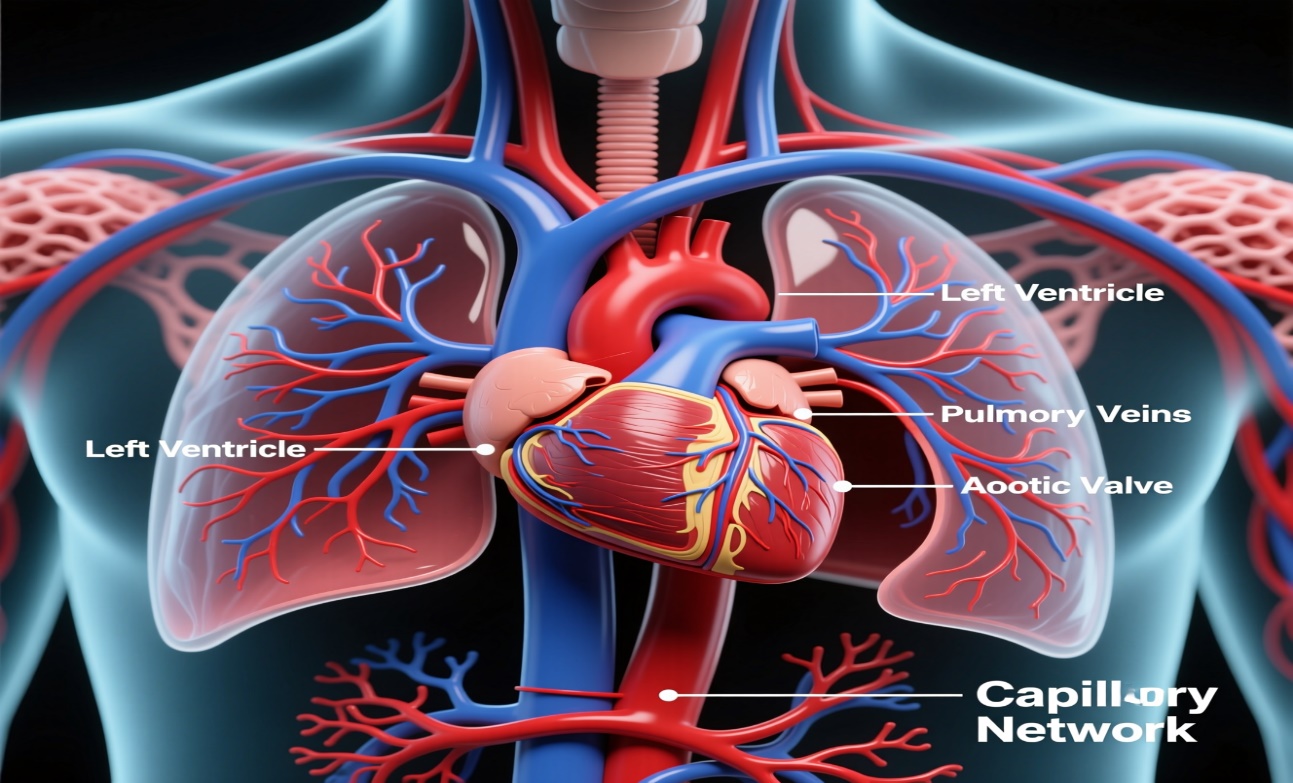
The right ventricle pumps deoxygenated blood into the lungs, where it is oxygenated. The oxygenated blood is brought back to the left atrium, and from there, it is pumped into the left ventricle. Finally, blood goes into the aorta for systemic circulation.
Systemic circulation
The oxygenated blood is pumped to various parts of the body from the left ventricle. The deoxygenated blood from different parts of the body passes through the vena cava to reach the right atrium. The right atrium transfers the blood into the right ventricle.
12. What are the differences between the transport of materials in the xylem and phloem?
Solution:
|
Transport of Materials in Xylem |
Transport of Materials in Phloem |
|
Xylem tissue helps in the transport of water and minerals. |
Phloem tissue helps in the transport of food. |
|
Water is transported upwards from roots to all other plant parts. |
Food is transported in both upward and downward directions. |
13. Compare the functioning of alveoli in the lungs and nephrons in the kidneys with respect to their structure and functioning.
Solution:
|
Alveoli |
Nephrons |
|
Structure |
Structure |
|
(i) Alveoli are tiny balloon-like structures present inside the lungs. |
(i) Nephrons are tubular structures present inside the kidneys. |
|
(ii) The walls of the alveoli are one cell thick, and it contains an extensive network of blood capillaries. |
(ii) Nephrons are made of glomerulus, Bowman’s capsule, and a long renal tube. |
|
Function |
Function |
|
(i) The exchange of O2 and CO2 takes place between the blood of the capillaries that surround the alveoli and the gases present in the alveoli. |
(i) The blood enters the kidneys through the renal artery. The blood is entered here, and the nitrogenous waste in the form of urine is collected by the collecting duct. |
|
(ii) Alveoli are the site of gaseous exchange. |
(ii) Nephrons are the basic filtration unit. |