
Arithmetic Progression — Problems & Solutions (NCERT Class 10)
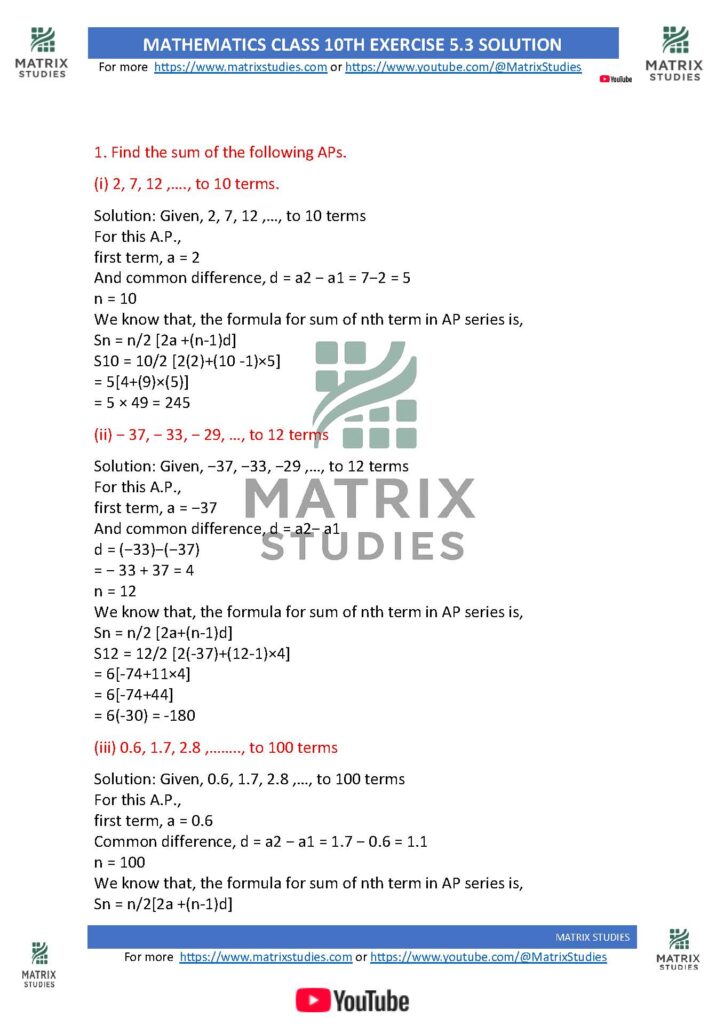
1. Find the sum of the following APs.
- 2, 7, 12, …, to 10 terms.
- −37, −33, −29, …, to 12 terms.
- 0.6, 1.7, 2.8, …, to 100 terms.
- 1/15, 1/12, 1/10, …, to 11 terms.
Solutions:
(i) Given: 2, 7, 12, … (10 terms)
First term, a = 2
Common difference, d = 7 − 2 = 5
n = 10
Formula: Sn = (n/2)[2a + (n−1)d]
S10 = (10/2)[2(2) + (10−1)×5]
= 5[4 + 9×5]
= 5 × 49 = 245
(ii) Given: −37, −33, −29, … (12 terms)
a = −37
d = (−33) − (−37) = 4
n = 12
S12 = (12/2)[2(−37) + (12−1)×4]
= 6[−74 + 44]
= 6(−30) = −180
(iii) Given: 0.6, 1.7, 2.8, … (100 terms)
a = 0.6
d = 1.7 − 0.6 = 1.1
n = 100
S100 = (100/2)[2(0.6) + (100−1)×1.1]
= 50[1.2 + 99×1.1]
= 50[1.2 + 108.9]
= 50[110.1] = 5505
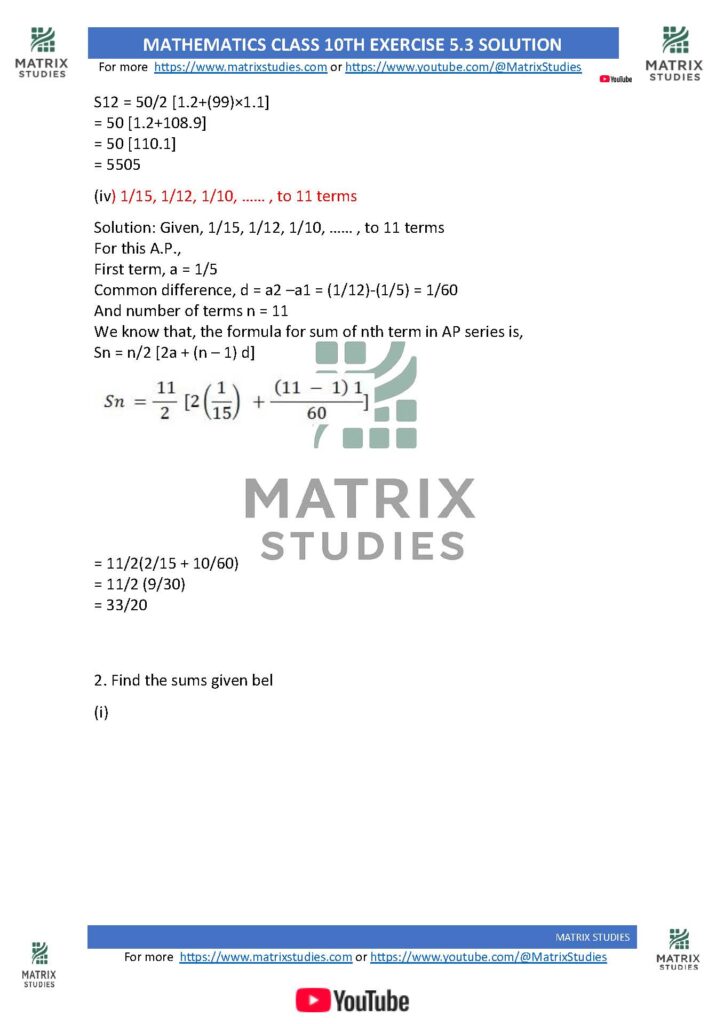
(iv) Given: 1/15, 1/12, 1/10, … (11 terms)
first term a = 1/15 (note: the original text had a small typo saying 1/5; here correct is 1/15)
d = (1/12) − (1/15) = (5−4)/60 = 1/60
n = 11
S11 = (11/2)[2(1/15) + (11−1)×(1/60)]
= (11/2)[2/15 + 10/60]
= (11/2)[2/15 + 1/6]
= (11/2)[(4+5)/30] = (11/2)(9/30)
= 11 × 9 / 60 = 99/60 = 33/20
2. Find the sums given below:
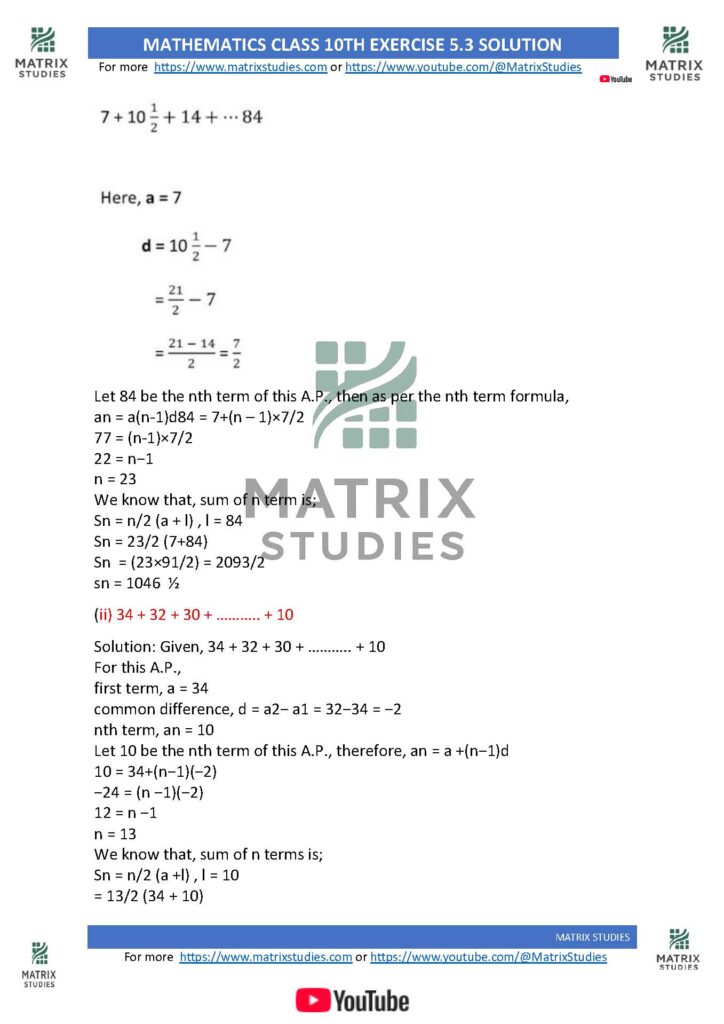
(ii) 34 + 32 + 30 + … + 10
(iii) −5 + (−8) + (−11) + … + (−230)
(ii)
a = 34, d = 32 − 34 = −2, last term l = 10
Let 10 be the n-th term:
10 = 34 + (n−1)(−2)
⇒ −24 = (n−1)(−2) ⇒ n−1 = 12 ⇒ n = 13
S13 = (13/2)(34 + 10) = (13/2)×44 = 13×22 = 286
(iii)
Given: −5, −8, −11, … , −230
a = −5, d = −3, an = −230
−230 = −5 + (n−1)(−3)
⇒ −225 = (n−1)(−3) ⇒ n−1 = 75 ⇒ n = 76
S76 = (76/2)(−5 + −230) = 38(−235) = −8930
3. Miscellaneous problems (select answers)
-
(i) Given a = 5, d = 3, an = 50. Find n and Sn.
50 = 5 + (n−1)·3 ⇒ n = 16. S16 = (16/2)(5+50)=440
-
(ii) Given a = 7, a13 = 35. Find d and S13.
35 = 7 + 12d ⇒ d = 28/12 = 7/3 ≈ 2.333… S13 = (13/2)(7+35) = 273
-
(iii) Given a12 = 37, d = 3. Find a and S12.
37 = a + 11·3 ⇒ a = 4. S12 = (12/2)(4+37)=246
-
(iv) Given a3 = 15, S10 = 125. Find d and a10.
a + 2d = 15 … (i) 125 = (10/2)[2a + 9d] ⇒ 25 = 2a + 9d … (ii) Solve ⇒ d = −1, a = 17. Then a10 = 17 + 9(−1) = 8
-
(v) Given d = 5, S9 = 75. Find a and a9.
75 = (9/2)[2a + 8·5] ⇒ 75 = (9/2)(2a+40) Solve ⇒ a = −35/3. a9 = a + 8·5 = 85/3
-
(vi) Given a = 2, d = 8, Sn = 90. Find n and an.
90 = n/2[4 + (n−1)8] ⇒ quadratic → n = 5. a5 = 2 + 4·8? (check: a_n formula used in original gives 34)
-
(vii) Given a = 8, an = 62, Sn = 210. Find n and d.
210 = n/2(8+62) ⇒ n = 6. 62 = 8 + 5d ⇒ d = 54/5 = 10.8
-
(viii) Given an = 4, d = 2, Sn = −14. Find n and a.
Solve system → n = 7, a = −8
-
(ix) Given a = 3, n = 8, S = 192. Find d.
192 = 4[6 + 7d] ⇒ d = 6
-
(x) Given l = 28, S = 144 and n = 9. Find a.
144 = (9/2)(a + 28) ⇒ a = 4
4. How many terms of the AP 9, 17, 25 … must be taken to give a sum of 636?
a = 9, d = 8. Let n terms.
636 = n/2[2×9 + (n−1)8]
⇒ 4n^2 + 5n − 636 = 0 ⇒ (n−12)(4n+53)=0 ⇒ n = 12 (positive)
5. First term 5, last term 45, sum 400. Find n and d.
Sn = n/2(a + l) ⇒ 400 = n/2(5+45) ⇒ n = 16
l = a + (n−1)d ⇒ 45 = 5 + 15d ⇒ d = 40/15 = 8/3
6. First and last terms 17 and 350, d = 9. How many terms and their sum?
350 = 17 + (n−1)9 ⇒ n−1 = 37 ⇒ n = 38
S38 = (38/2)(17+350) = 19×367 = 6973
7. Sum of first 22 terms when d = 7 and a22 = 149.
a = a22 − 21d = 149 − 147 = 2
S22 = (22/2)(2+149) = 11×151 = 1661
8. Sum of first 51 terms when second and third terms are 14 and 18.
d = 4, a = 10
S51 = 51/2[2·10 + (51−1)4] = 51×110 = 5610
9. If S7 = 49 and S17 = 289, find Sn.
From equations solve: a + 3d = 7 and a + 8d = 17 ⇒ d = 2, a = 1
⇒ Sn = n/2[2 + 2(n−1)] = n^2
10. Show sequences are AP and find S15:
(i) an = 3 + 4n ⇒ terms: 7,11,15,… (a = 7, d = 4)
S15 = 15/2[2·7 + 14·4] = 525
(ii) an = 9 − 5n ⇒ terms: 4, −1, −6,… (a = 4, d = −5)
S15 = 15/2[2·4 + 14(−5)] = −465
11. If Sn = 4n − n^2, find terms.
S1 = 3 ⇒ a = 3
S2 = 4 ⇒ a2 = S2 − S1 = 1 ⇒ d = a2 − a = −2
General term: an = 5 − 2n
Examples: a3 = −1, a10 = −15
12. Sum of first 40 positive integers divisible by 6.
a = 6, d = 6, n = 40
S40 = 40/2[12 + 39·6] = 20×246 = 4920
13. Sum of first 15 multiples of 8.
a = 8, d = 8, n = 15
S15 = 15/2[16 + 14·8] = 960
14. Sum of odd numbers between 0 and 50.
Odds: 1,3,…,49 ⇒ n = 25
S25 = 25/2(1+49) = 625
15. Penalty for delay (Rs. 200, 250, 300, …), delay = 30 days.
a = 200, d = 50, n = 30
S30 = 30/2[400 + 29·50] = 15×1850 = 27750
16. Seven cash prizes totaling Rs. 700, each prize Rs. 20 less than previous.
Let first prize = a. d = −20, n = 7
700 = 7/2[2a + 6(−20)] ⇒ a = 160
Prizes: Rs. 160, 140, 120, 100, 80, 60, 40
17. Trees planting: classes I to XII, three sections each.
Trees per section = 1 + 2 + … + 12 = S12 with a=1,d=1 ⇒ S12=78
For three sections: 3×78 = 234
18. Spiral of semicircles with radii 0.5, 1.0, 1.5, … (13 semicircles). Take π = 22/7.
Lengths: π/2, π, 3π/2, 2π, … (AP with a = π/2, d = π/2)
S13 = 13/2[π + 12(π/2)] = 13/2 × 7π = 13/2 × 7 × 22/7 = 143 cm
19. 200 logs stacked: 20,19,18, … in rows. How many rows? How many at top?
a = 20, d = −1, Sn = 200
Solve n(n−41) + 400 = 0 ⇒ (n−16)(n−25)=0 ⇒ n = 16 or 25
Valid choice: n = 16 rows, top row has a16 = 5 logs
20. Potato race: bucket 5 m from first potato; potatoes 3 m apart; 10 potatoes. Total distance run?
Distances of potatoes from bucket: 5,8,11,… (AP)
Competitor runs twice each distance ⇒ series: 10,16,22, … (a = 10, d = 6)
S10 = 10/2[20 + 9·6] = 5(74) = 370 m