
Exercise Set 1.1 Class 9 · Ganita Manjari
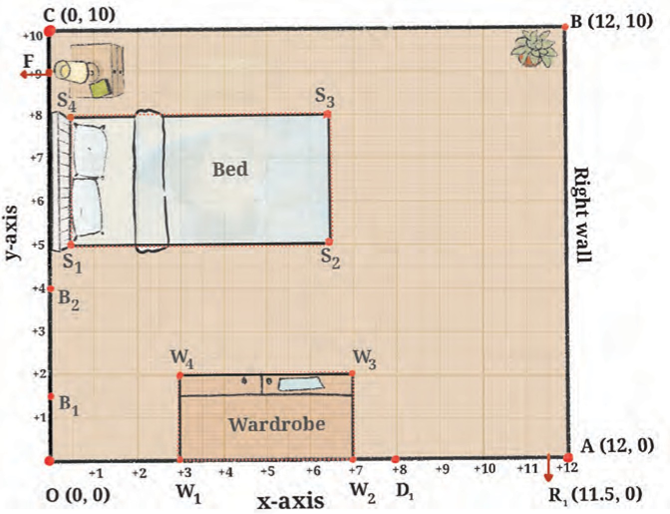
The door lies along the x‑axis, so its distance from the x‑axis is 0 units.
From the figure, D₁ = (8, 0) and R₁ = (11.5, 0).
Therefore, the door begins 8 units from the y‑axis (the left wall).
The coordinates of D₁ are (8, 0).
Coordinates of D₁ = (8, 0) and R₁ = (11.5, 0).
So, the width of the door = distance between D₁ and R₁ = 11.5 – 8 = 3.5 units.
If one unit represents one foot, then 3.5 ft ≈ 42 inches, which is a comfortable width for a room door. Standard residential doors are usually 30–36 inches wide, so this door is slightly wider than average, which is beneficial.
For wheelchair accessibility, a wheelchair typically requires a clear width of at least 32 inches (about 2.7 ft). Since 3.5 ft is greater than 2.7 ft, the door is wide enough. Therefore, the door is comfortable in size and a person in a wheelchair can enter easily.
Coordinates of B₁ = (0, 1.5) and B₂ = (0, 4).
So, the width of the bathroom door = distance between B₁ and B₂ = 4 – 1.5 = 2.5 units.
Since 2.5 < 3.5, the bathroom door is narrower than the room door.